 |
Spicy
|
|
Spicy
|
#include <node.h>
Public Member Functions | |
| node::Tag | nodeTag () const |
| bool | hasParent () const |
| Node * | parent (int i=1) const |
| template<typename T > | |
| T * | parent () const |
| auto | pathLength () const |
| const auto & | meta () const |
| const auto & | location () const |
| void | setMeta (Meta m) |
| auto | scope () const |
| auto | getOrCreateScope () |
| void | clearScope () |
| Result< std::pair< Declaration *, ID > > | lookupID (const ID &id, const std::string_view &what) const |
| virtual bool | inheritScope () const |
| std::string | typename_ () const |
| uint64_t | identity () const |
| const auto & | children () const |
| template<typename T > | |
| T * | child (unsigned int i) const |
| template<typename T > | |
| T * | childTryAs (unsigned int i) const |
| Node * | child (unsigned int i) const |
| template<typename T > | |
| auto | children (int begin, std::optional< int > end) const |
| template<typename T > | |
| auto | children (int begin, std::optional< int > end) |
| template<typename T > | |
| node::Set< T > | childrenOfType () const |
| bool | hasChild (const Node *n, bool recurse=false) const |
| Node * | sibling (Node *n) const |
| void | addChild (ASTContext *ctx, Node *n) |
| void | addChildren (ASTContext *ctx, const Nodes &children) |
| void | removeChild (Node *n) |
| void | removeChildren (int begin, std::optional< int > end) |
| void | setChild (ASTContext *ctx, size_t idx, Node *n) |
| void | replaceChildren (ASTContext *ctx, const Nodes &children) |
| void | replaceChild (ASTContext *ctx, Node *old, Node *new_) |
| template<typename T > | |
| bool | isA () const |
| template<typename T > | |
| bool | isA_ () const |
| template<typename T > | |
| T * | as () const |
| template<typename T > | |
| T * | as () |
| template<typename T > | |
| const T * | tryAs () const |
| template<typename T > | |
| T * | tryAs () |
| template<typename T > | |
| T * | tryAs_ () |
| void | print (std::ostream &out, bool compact, bool user_visible) const |
| std::string | print () const |
| std::string | printRaw () const |
| operator std::string () const | |
| std::string | dump () const |
| std::string | renderSelf (bool include_location=true) const |
| void | addError (std::string msg, std::vector< std::string > context={}) |
| void | addError (std::string msg, node::ErrorPriority priority, std::vector< std::string > context={}) |
| void | addError (std::string msg, const Location &l, std::vector< std::string > context={}) |
| void | addError (std::string msg, Location l, node::ErrorPriority priority, std::vector< std::string > context={}) |
| bool | hasErrors () const |
| const auto & | errors () const |
| void | clearErrors () |
| void | clearChildren () |
| void | retain () |
| void | release () |
| bool | isRetained () const |
| virtual node::Properties | properties () const |
| virtual void | dispatch (visitor::Dispatcher &v)=0 |
| virtual std::string_view | branchTag () const |
| Node & | operator= (const Node &other)=delete |
| Node & | operator= (Node &&other) noexcept=delete |
Protected Member Functions | |
| Node (ASTContext *ctx, node::Tags node_tags, Nodes children, Meta meta) | |
| Node (ASTContext *ctx, node::Tags node_tags, Meta meta) | |
| Node (Node &&other)=default | |
| Node (const Node &other) | |
| virtual std::string | _typename () const |
| virtual Node * | _clone (ASTContext *ctx) const =0 |
| virtual std::string | _dump () const |
Friends | |
| Node * | node::detail::deepcopy (ASTContext *ctx, Node *n, bool force) |
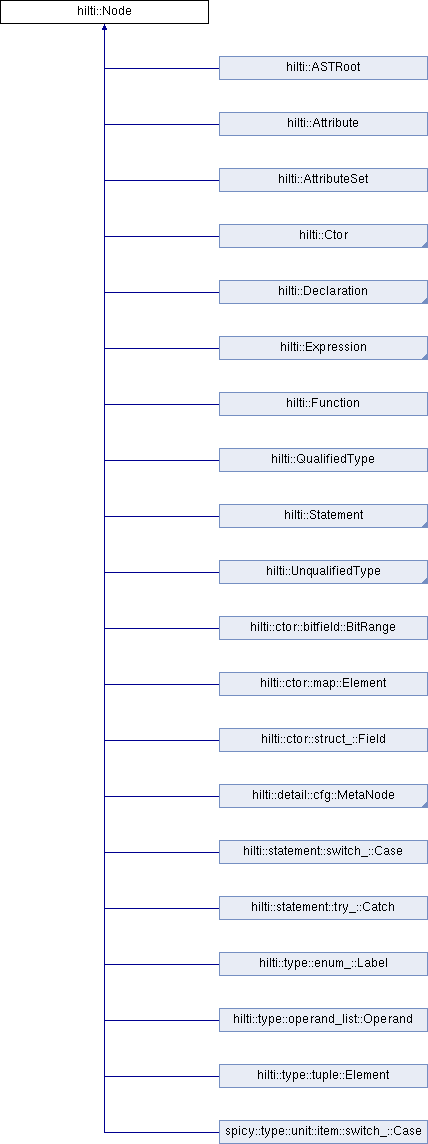
Base class for all AST nodes.
|
inlineprotected |
Constructor initializing the node with children and meta data. The semantics for the children's parent pointering and potential deep-copying are the same as if they were added individually through addChild().
| ctx | current context in use |
| children | child nodes to add initially |
|
inlineprotected |
Constructor initializing the node with meta data but no children.
|
inlineprotected |
Copy constructor. This copies only meta data and internal flags, but not any children. The parent of the copied node will be unset.
Use node::deepcopy() to fully copy a node.
|
protectedpure virtual |
Performs a shallow copy. A new instance of the current node class is created and initialized with copies of all attributes and children with latter being copied just by reference. This is for internal use only, use node::deepcopy() to fully clone nodes.
|
inlineprotectedvirtual |
Returns additional information to include into the node's dump() output, as provided by derived classes.
Reimplemented in hilti::UnqualifiedType, hilti::Statement, hilti::Function, hilti::Expression, hilti::declaration::Parameter, hilti::declaration::Module, hilti::declaration::Field, hilti::Declaration, hilti::Ctor, hilti::AttributeSet, hilti::Attribute, hilti::QualifiedType, hilti::statement::try_::Catch, hilti::statement::switch_::Case, hilti::ctor::map::Element, and hilti::ASTRoot.
|
inlineprotectedvirtual |
Returns the C++-level class name for the node's type. This is for internal use only. It's the virtual backend to typename_(), which is the one to call instead of this method.
|
inline |
Adds a child node. The node will be appended to the end of the current list of children, and its parent will be set to the current node. If the node already has a parent, it will be deep-copied first, and the new instance will be added instead of the once passed in. ×
| ctx | current context in use |
| n | child node to add; it's ok for this to be null to leave a child slot unset |
|
inline |
Adds a series of child nodes. This operates like calling addChild() on each of them individually.
| ctx | current context in use |
| children | nodes to add |
|
inline |
Associates an error message with the node. The error will have normal priority.
| msg | error message to report |
| l | custom location to associate with the error |
| context | further lines of context to show along with error |
|
inline |
Associates an error message with the node.
| msg | error message to report |
| l | custom location to associate with the error |
| priority | importance of showing the error |
| context | further lines of context to show along with error |
|
inline |
Associates an error message with the node. The error's location will be that of the current node.
| msg | error message to report |
| priority | importance of showing the error |
| context | further lines of context to show along with error |
|
inline |
Associates an error message with the node. The error's location will be that of the current node, and it will have normal priority.
| msg | error message to report |
| context | further lines of context to show along with error |
|
inline |
Casts a node into a particular class. The cast from the node to the target type must be valid. If it isn't, in release builds, the call will result in undefined behavior (and probably crash). In debug builds, we'll catch invalid cases and abort with an internal error.
|
inline |
Casts a node into a particular class. The cast must be a valid C++ dynamic pointer cast, otherwise execution will abort with an internal error.
|
inlinevirtual |
Optional tag associated with the AST subbranch that this node is the top of. If a tag is returned, this may be used to by visitors to skip the subbranch entirely based on that tag.
Reimplemented in hilti::declaration::Module.
|
inline |
Returns a child.
| T | type that the child nodes are assumed to (and must) have |
| i | zero-based index of the child, in the order they were passed into the constructor and/or added |
T, or null if there's no child node at that index
|
inline |
Returns a child at given index inside the vector of all children. The order in that vector is determined by the order in which the children were passed into the constructor and/or added.
| i | index of the child, with zero being the first |
|
inline |
Returns the set of all children.
|
inline |
Returns a subrange of children. The indices correspond to the order children were passed into the constructor and/or added.
| T | type that the child nodes are assumed to (and must) have |
| begin | index of first child to include |
| end | index of one beyond last child to include; a negative index for end counts Python-style from end of list; if not given, all children from start to the end of the list are returned |
start to end
|
inline |
Returns a subrange of children. The indices correspond to the order children were passed into the constructor and/or added.
| T | type that the child nodes are assumed to (and must) have |
| begin | index of first child to include |
| end | index of one beyond last child to include; a negative index for end counts Python-style from end of list; if not given, all children from start to the end of the list are returned |
start to end
|
inline |
Returns a subset of children selected by their type.
| T | type of children to return |
T
|
inline |
Returns a child.
| T | type that the child nodes are assumed to (and must) have |
| i | zero-based index of the child, in the order they were passed into the constructor and/or added |
T, or null if there's no child node at that index | void Node::clearChildren | ( | ) |
Removes all children from the node. It doesn't destroy the children, pointers remain valid, it just unlinks them from their current parent.
|
inline |
Clears any error message associated with the node.
|
inline |
Removes any associated scope from the node. Afterwards, scope() will return null again.
|
pure virtual |
Dispatch for the visitor API.
| std::string Node::dump | ( | ) | const |
Returns an internal string representation of the node and all its children. Note that this can be called from inside a debugger.
|
inline |
Returns any error messages associated with the node.
|
inline |
Returns the node's direct scope if already created, or creates one if it hasn't yet. In the latter case, the new scope is permanently associated with the node before being returned.
|
inline |
Returns true if the node's children contain a particular child node.
| n | child node to look for |
| recurse | if true, will also check children of children recursively |
|
inline |
Returns true if there are any errors associated with the node.
|
inline |
Returns true if the node has a parent (i.e., it's part of an AST).
|
inline |
Returns a globally unique numeric identifier for the node.
|
inlinevirtual |
Returns a flag indicating whether a scope lookup passing this node shall find IDs in parent nodes as well. This returns true by default.
Reimplemented in spicy::type::Unit.
|
inline |
Returns true if a node is of a particular type (class).
|
inline |
Alternate version to check if a node is of a particular type (class). This version skips any potential internal consistency checks, which can be helpful in case of false positives. You should normally avoid using this unless absolutely necessary.
|
inline |
Returns true if at least one party has currently retained the node.
|
inline |
Short-cut to return the location from the node's meta information.
| Result< std::pair< Declaration *, ID > > Node::lookupID | ( | const ID & | id, |
| const std::string_view & | what | ||
| ) | const |
Looks up an ID in the node's chain of scope, following HILTI's scoping and visibility rules.
| id | id to look up |
| what | description of what we're looking for, for error reporting |
|
inline |
Returns the meta data associated with the node.
|
inline |
Returns the node tag associated with the instance's class.
|
inline |
Renders the node as HILTI source code, using the same semantics as print().
|
inline |
Returns the first parent node of a give type.
| T | type of parent to search |
|
inline |
Returns a parent node, assuming the node is part of an AST.
| i | level of the parent to return, counting from 1 for the immediate parent |
|
inline |
Returns the length of the AST path to the current node from the AST's root. If the node is part of an AST, returns a number >= 1. If it is not (i.e., there's no parent node), returns 0.
| std::string Node::print | ( | ) | const |
Returns a HILTI source code representation of the node and all its children. This always renders the code as "user-visible", per the flag in the extended version of print().
Note that this can be called from inside a debugger.
| void Node::print | ( | std::ostream & | out, |
| bool | compact, | ||
| bool | user_visible | ||
| ) | const |
Print out a HILTI source code representation of the node and all its children. If the node is not the root of an AST, it's not guaranteed that the result will form valid HILTI source code (but it can still be used, e.g., in error messages).
| out | output stream |
| compact | create a one-line representation |
| user_visible | if true, signal to the printer that the output is intended for user consumption, permitting it to do some visual polishing |
| std::string Node::printRaw | ( | ) | const |
Returns a HILTI source code representation of the node and all its children. This always renders the code as not "user-visible", per the flag in the extended version of Zeek.
Note that this can be called from inside a debugger.
|
inlinevirtual |
Returns any instance properties associated with the node. These are used (only) for debug logging. Derived classes should override this to add any properties they retain inside internal node member variables.
Reimplemented in hilti::QualifiedType, hilti::UnqualifiedType, hilti::Function, hilti::expression::ResolvedOperator, hilti::declaration::Module, hilti::Declaration, hilti::ctor::Struct, hilti::ctor::struct_::Field, spicy::type::Unit, spicy::type::unit::item::UnresolvedField, spicy::type::unit::item::switch_::Case, spicy::type::unit::item::Field, spicy::declaration::Hook, hilti::type::tuple::Element, hilti::type::operand_list::Operand, hilti::type::Name, hilti::type::Member, hilti::type::Library, hilti::type::detail::IntegerBase, hilti::type::Function, hilti::type::enum_::Label, hilti::type::Bitfield, hilti::type::bitfield::BitRange, hilti::statement::Comment, hilti::statement::Assert, hilti::operator_::reference::DerefBase, hilti::expression::UnresolvedOperator, hilti::expression::Name, hilti::expression::Member, hilti::expression::Keyword, hilti::expression::BuiltInFunction, hilti::declaration::Type, hilti::declaration::Parameter, hilti::declaration::ImportedModule, hilti::declaration::Function, hilti::declaration::Field, hilti::ctor::Time, hilti::ctor::String, hilti::ctor::Stream, hilti::ctor::RegExp, hilti::ctor::Real, hilti::ctor::Port, hilti::ctor::Network, hilti::ctor::Interval, hilti::ctor::detail::IntegerBase< Value >, hilti::ctor::detail::IntegerBase< int64_t >, hilti::ctor::detail::IntegerBase< uint64_t >, hilti::ctor::Error, hilti::ctor::Bytes, hilti::ctor::Bool, hilti::ctor::bitfield::BitRange, hilti::ctor::Address, and hilti::Attribute.
|
inline |
Unpins the node, allowing garbage collection to delete it (assuming no other pins).
|
inline |
Removes a child from the node. It's parent will be set back to null. Does nothing if the child isn't found.
| n | child node to remove |
|
inline |
Removes a range of children from the node. They nodes won't be destroyed but their parents will be reset back to null.
| begin | index of first child to remove |
| end | index of one beyond last child to include; a negative index for end counts Python-style from end of list; if not given, all children from start to the end of the list are returned |
| std::string Node::renderSelf | ( | bool | include_location = true | ) | const |
Returns an internal string representation of the node itself, excluding its children.
| include_location | if true, include source code locations into the output |
| void Node::replaceChild | ( | ASTContext * | ctx, |
| Node * | old, | ||
| Node * | new_ | ||
| ) |
Replaces a single child with a new one. The old one is removed, and the new one is then stored at the old one's index. Semantics for parent pointering and deep-copying are the same as removing/adding individual children.
| ctx | current context in use |
| old | child to replace, which must exist (otherwise the method will abort with an internal error) |
| new_ | new child to replace old with |
| void Node::replaceChildren | ( | ASTContext * | ctx, |
| const Nodes & | children | ||
| ) |
Replaces all children with a new set children. The function operates like first removing all children, and then adding all the new ones in the same order, with the same semantics for parent pointering and deep-copying as adding/removing individual children exhibits.
| ctx | current context in use |
| children | new children to set |
|
inline |
Pins the node in memory, ensuring garbage collection won't delete it.
|
inline |
Returns the scope associated with the node, if any. Returns null if no scope has been created for the node yet.
|
inline |
Sets the child at a particular index. Its parent will be set to the current node. If the node already has a parent, it will be deep-copied first, and the new instance will be added instead of the once passed in. If there's an existing child at that index, it'll be removed first and its parent cleared.
| ctx | current context in use |
| idx | index of child to set |
| n | child node to set; this may be null to unset the particular index |
|
inline |
Sets the meta data associated with the node.
Returns the subsequent sibling of given child node. This skips over null children.
| n | child whose sibling to return |
|
inline |
Attempts to casts a node into a particular class. Returns a nullptr if the cast failed.
|
inline |
Attempts to casts a node into a particular class. Returns a nullptr if the cast failed.
|
inline |
Alternate version to attempt casting a node into a particular class. Returns a nullptr if the cast failed. This version skips any potential internal consistency checks, which can be helpful in case of false positives. You should normally avoid using this unless absolutely necessary.
|
inline |
Returns the C++-level type for the nodes' class. This should be only used for for debugging purposes.
 1.9.1
1.9.1