ZeroMQ Cluster Backend
Added in version 7.1.
Quickstart
To switch a Zeek cluster with a static cluster layout over to use ZeroMQ
as cluster backend, add the following snippet to local.zeek:
@load frameworks/cluster/backend/zeromq
Note that the function Broker::publish will be non-functional
and a warning emitted when used - use Cluster::publish instead.
By default, a configuration based on hard-coded endpoints and cluster layout information is created. For more customization, refer to the module documentation at cluster/backend/zeromq/main.zeek.
Architecture
Publish-Subscribe of Zeek Events
The ZeroMQ based cluster backend uses a central
XPUB/XSUB broker for publish-subscribe functionality. Zeek events published
via Cluster::publish are distributed by this central broker to
interested nodes.
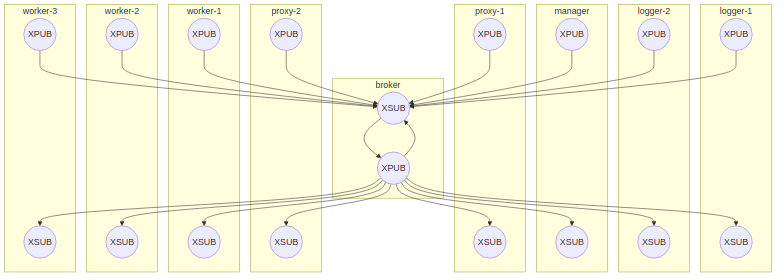
As depicted in the figure above, each cluster node connects to the central broker twice, once via its XPUB socket and once via its XSUB socket. This results in two TCP connections from every cluster node to the central broker. This setup allows every node in the cluster to see messages from all other nodes, avoiding the need for cluster topology awareness.
Note
If you observe the central broker as a bottleneck in your setup, please reach out with information about your environment and workload. We’re generally confident that ZeroMQ is fast enough for known and normal Zeek clusters sizes and likely more performant than the previous cluster backend Broker. Specifically for broadcast style worker-to-worker messaging patterns that previously had to be routed through the manager node, ZeroMQ should reduce time spent in manager script execution.
On a cluster node, the XPUB socket provides notifications about subscriptions
created by other nodes: For every subscription created by any node in
the cluster, the Cluster::Backend::ZeroMQ::subscription event is
raised locally on every other node (unless another node had created the same
subscription previously).
This mechanism is used to discover the existence of other cluster nodes by
matching the topics with the prefix for node specific subscriptions as produced
by Cluster::nodeid_topic.
As of now, the implementation of the central broker calls ZeroMQ’s
zmq::proxy() function to forward messages between the XPUB and
XSUB socket.
While the diagram above indicates the central broker being deployed separately from Zeek cluster nodes, by default the manager node will start and run this broker using a separate thread. There’s nothing that would prevent from running a long running central broker independently from the Zeek cluster nodes, however.
The serialization of Zeek events is done by the selected
Cluster::event_serializer and is independent of ZeroMQ.
The central broker needs no knowledge about the chosen format, it is
only shuffling messages between nodes.
Logging
While remote events always pass through the central broker, nodes connect and
send log writes directly to logger nodes in a cluster. The ZeroMQ cluster backend
leverages ZeroMQ’s pipeline pattern for this functionality. That is, logger nodes
(including the manager if configured using Cluster::manager_is_logger)
open a ZeroMQ PULL socket to receive log writes. All other nodes connect their
PUSH socket to all available PULL sockets. These connections are separate from
the publish-subscribe setup outlined above.
When sending log-writes over a PUSH socket, load balancing is done by ZeroMQ. Individual cluster nodes do not have control over the decision which logger node receives log writes at any given time.
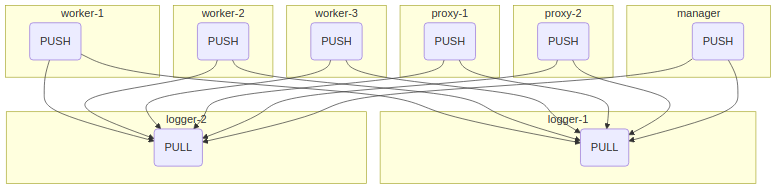
While the previous paragraph used “log writes”, a single message to a logger
node actually contains a batch of log writes. The options Log::flush_interval
and Log::write_buffer_size control the frequency and maximum size
of these batches.
The serialization format used to encode such batches is controlled by the
selected Cluster::log_serializer and is independent of ZeroMQ.
With the default serializer (Cluster::LOG_SERIALIZER_ZEEK_BIN_V1),
every log batch on the wire has a header prepended that describes it. This allows
interpretation of log writes even by non-Zeek processes. This opens the possibility
to implement non-Zeek logger processes as long as the chosen serializer format
is understood by the receiving process. In the future, a JSON lines serialization
may be provided, allowing easier interpretation than a proprietary binary format.
Summary
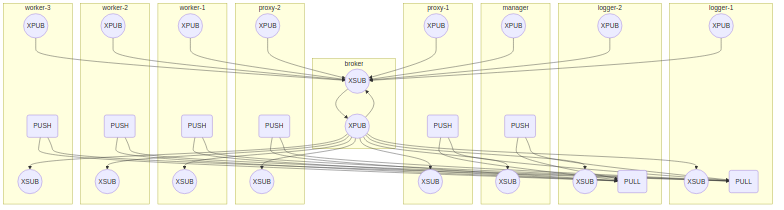
Combining the diagrams above, the connections between the different socket types in a Zeek cluster looks something like the following.
Encryption
Added in version 8.2.
When using ZeroMQ as a cluster backend, communication between Zeek nodes is unencrypted by default. Refer to the module documentation at cluster/backend/zeromq/main.zeek for details and background how to setup encryption using the CURVE mechanism.
ZeekControl will automatically configure encryption and distribute the server and client keys when multiple physical systems (based on IP addresses) form a Zeek cluster. For single system setups, encryption is disabled by default.